• 4 foil-sealed test strips

  • 10 ml preservative-free drops, no BAK

  • $59 once, no subscription

  • Preservative-free, no BAK

  • Strips foil-sealed with desiccant

  • Free U.S. shipping, 2-5 business days

  • 60-day money back, opened or not

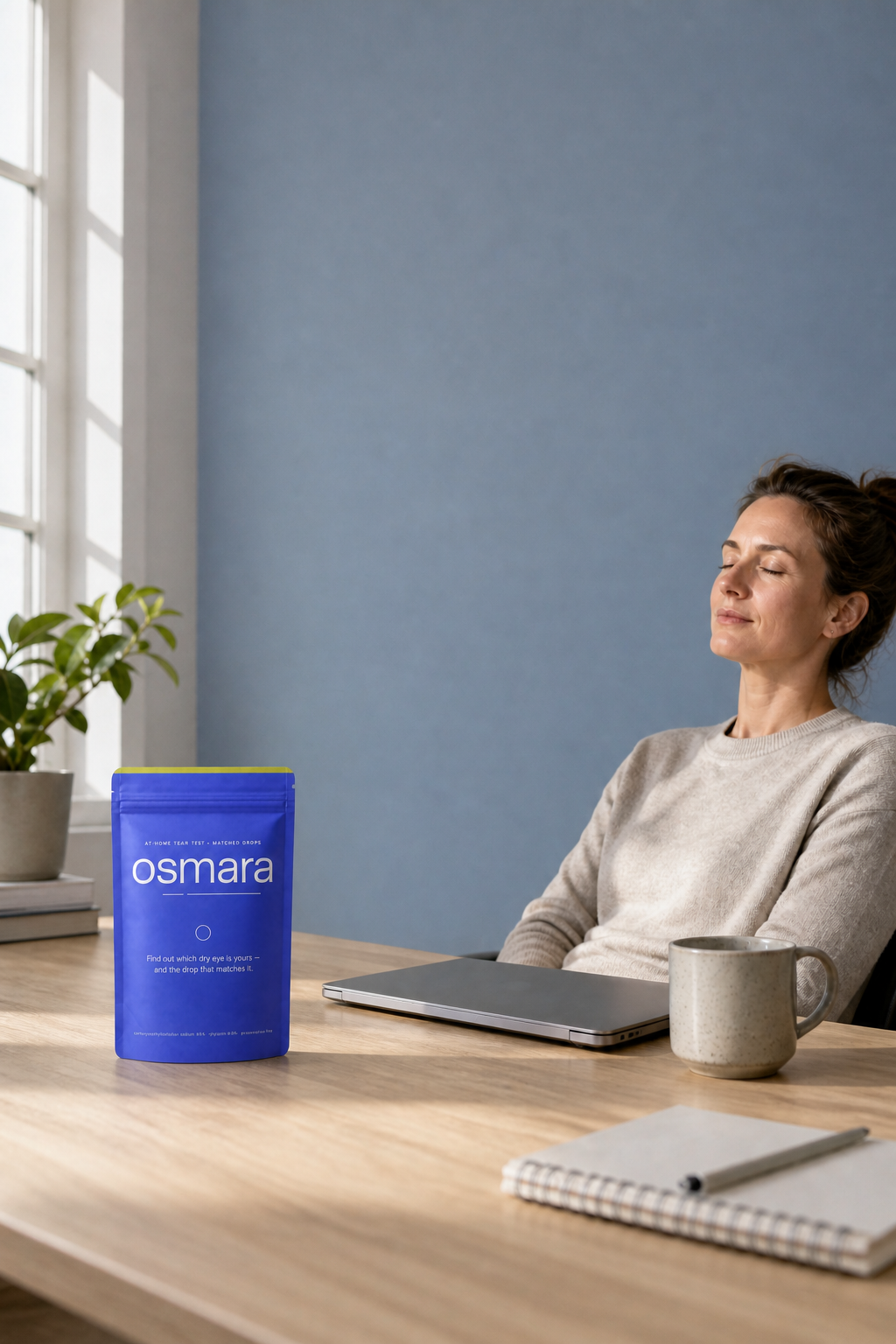
product — campaign (tall)

The drawer of bottles

Dozens of drops on the shelf. No way to know which one is yours.

The aisle carries plain lubricants, lipid emulsions, gels, preservative-free vials and redness drops. The boxes look almost the same. So most people buy by price, use half the bottle, and try something else next month. That's how a desk drawer ends up with three open bottles and no answer.

Meanwhile the symptoms get specific. Burning by 3pm on two monitors. Grittiness that comes back within the hour. Headlights that smear on the drive home badly enough that you slow down.

You can't fix that by guessing harder. You need a read: a number for your tear film and a score for your symptoms, taken on the same morning, and taken again a few weeks later so you can see if anything moved.

  • Tear osmolarity

    The saltiness of your tear film. When tears evaporate faster than they're replaced, what's left behind gets more concentrated, so a number here gives you an objective read on how stressed your tear film is, instead of guessing from how your eyes feel that day.

    In a 314-subject multicentre comparison of six dry eye tests (Lemp 2011), osmolarity had the best overall performance, with an ROC area of 0.89. A later cross-sectional study of 786 people (Scientific Reports, 2020) found the opposite: osmolarity alone failed to separate patients from controls at any cutoff tested. That's why we pair the number with a symptom score instead of reading it alone. Funding details weren't captured in the sources we reviewed.

  • Validated symptom questionnaire

    A scored, standardised set of questions about grittiness, burning, screen time, night driving and light sensitivity. It turns 'my eyes have felt off for two years' into a number you can track and compare week to week.

    The Ocular Surface Disease Index was validated in 139 people (Schiffman 2000) with good to excellent internal consistency, Cronbach's alpha 0.92, and good test-retest reliability. Honest limit from that same data: the scores did not track clinical tests closely, with correlations from -0.21 to +0.19. It measures how you feel, reliably. It does not replace an exam.

  • Carboxymethylcellulose sodium 0.5%

    A water-holding polymer that clings to the eye's surface and slows how fast the film thins out between blinks, so the surface stays wetter for longer after each drop.

    In a randomised blinded 8-week trial in 67 people (Lee 2011), preservative-free 0.5% carboxymethylcellulose dosed six times daily improved staining, break-up time and symptoms, and was judged equivalent to 0.1% sodium hyaluronate. Equivalent, not better. Anyone selling one polymer as decisively superior is overselling.

  • Glycerin 0.9%

    A small humectant that holds water in the tear film and softens the osmotic stress on surface cells when tears become over-concentrated.

    A 2-week multicentre randomised comparison (Roth 2011) of preservative-free carboxymethylcellulose 0.5% with glycerin 0.9% against sodium hyaluronate 0.18% found significant improvement from baseline in both groups on symptom scores, break-up time and staining, with no significant difference between them. Sponsor details weren't captured in the sources we reviewed.

Papers, not promises

The four studies this kit is built on

Read them yourself. Two of them limit what we can claim, and we left those in on purpose.

Tear osmolarityLemp MA, Bron AJ, Baudouin C, et al. 'Tear Osmolarity in the Diagnosis and Management of Dry Eye Disease.' American Journal of Ophthalmology, 2011;151(5):792–798Of the six tests compared, osmolarity had the best overall diagnostic performance, with the highest area under the ROC curve (0.89). The most sensitive threshold separating normal from mild/moderate subjects was 308 mOsm/L and the most specific was 315; at a 312 mOsm/L cutoff, sensitivity was 73% and specificity 92%. Other routine tests performed poorly in one direction or the other — corneal staining 54% and conjunctival staining 60% sensitivity, break-up time 45% and Schirmer 51% specificity.…
Tear osmolarity'Utility of Tear Osmolarity Measurement in Diagnosis of Dry Eye Disease.' Scientific Reports, 2020 (author list not captured in the sources reviewed)Unflattering and important: osmolarity was the only test that failed to separate patients from controls, at any cutoff tested (>308, >316, or an inter-eye difference >8 mOsm/L). Using the 308 mOsm/L cutoff, 58% of patient right eyes exceeded it — but so did 50% of control right eyes. The authors' conclusion is that a single osmolarity number cannot be read in isolation as a diagnosis. This is the main reason a reading here is paired with a symptom score and a human review rather than treated as…
Tear osmolarityWolffsohn JS, Arita R, Chalmers R, et al. 'TFOS DEWS II Diagnostic Methodology report.' The Ocular Surface, 2017;15(3):539–574The recommended sequence starts with symptom screening (DEQ-5 or OSDI); a positive screen then triggers break-up time, osmolarity and ocular surface staining. Crucially for anyone hoping one number sorts everything: sub-classification into predominantly evaporative or aqueous-deficient requires meibomian gland, lipid layer and tear volume assessment — osmolarity alone does not do it. The report also states plainly that normal and dry eye distributions overlap significantly for all current…
Validated symptom questionnaireSchiffman RM, Christianson MD, Jacobsen G, Hirsch JD, Reis BL. 'Reliability and validity of the Ocular Surface Disease Index.' Archives of Ophthalmology, 2000;118(5):615–621Internal consistency was good to excellent (Cronbach's alpha 0.92) and test–retest reliability was good to excellent, supporting the OSDI as a repeatable severity measure with three subscales: ocular symptoms, vision-related function and environmental triggers. The honest limitation, noted in later analyses of this same data: OSDI scores did not correlate well with clinical tests — correlations with break-up time, Schirmer, lissamine green and fluorescein staining ranged from −0.21 to +0.19 and…
Carboxymethylcellulose sodiumLee JH, Ahn HS, Kim EK, Kim TI. 'Efficacy of sodium hyaluronate and carboxymethylcellulose in treating mild to moderate dry eye disease.' Cornea, 2011;30(2):175–179Both preservative-free formulations improved corneal and conjunctival staining, tear break-up time and subjective symptoms, with safety maintained at frequent dosing. The efficacies of the two were judged equivalent — meaning carboxymethylcellulose 0.5% performed as well as a common comparator, not better than it. Anyone told a specific polymer is decisively superior to the others is being oversold.
GlycerinRoth HW, Conway T, Hollander DA. 'Evaluation of carboxymethylcellulose 0.5%/glycerin 0.9% and sodium hyaluronate 0.18% artificial tears in patients with mild to moderate dry eye.' Clinical Optometry…Both preservative-free formulations produced statistically significant improvements from baseline in OSDI symptom scores, tear break-up time, corneal and conjunctival staining and conjunctival hyperemia — but there were no statistically significant differences between the two groups on any measure. Non-significant trends went in both directions: sodium hyaluronate trended toward less blurring after instillation (P = 0.055), while CMC/glycerin trended toward longer symptom control and a better…

These studies tested tear osmolarity, the symptom index, and the drop ingredients. None of them tested this kit. Expert consensus (TFOS DEWS II, 2017) is also clear that a single osmolarity number cannot sort evaporative from aqueous-deficient dry eye on its own, and that normal and dry eye ranges overlap. So we don't claim it does.

product — Read At Home shot

How it fits a workday

Morning one: take the read

Before drops, before makeup. Touch one strip to the tear film at the outer edge of your lower lid, match the colour to the card, write the number down. Then score the symptom check in the same sitting. About ten minutes.

Close view of the 10 ml preservative-free dropper with its one-way filtered valve tip and cap beside it

How it fits a workday

Daily: one bottle, not four

Use the preservative-free drops as your eyes need them, up to about six times a day, which is the dosing studied for eight weeks. Keep the redness bottle out of the rotation. It isn't a lubricating tear.

product — Made For Home shot

How it fits a workday

Morning two: compare

Three weeks later, take a second reading and score the symptoms again. Two numbers side by side tell you more than any single bottle ever did. You have four strips, so you can do this twice.

Add a tagline

60 days to decide it told you something

Email hello@tryosmara.com within 60 days of delivery and we refund you in full, opened or not. You don't need to ship anything back.

Sixty days is enough for a first reading, a few weeks of daily drops, and a second reading. If that didn't give you more than the drawer of half-used bottles did, we'd rather give the money back.

Straight answers

The questions people ask before buying

Am I going to have to poke myself in the eye, or fail to make enough tears for it to even work?

Nothing touches the eyeball. The strip touches the tear film at the outer edge of your lower lid for a moment, about the same feeling as a lash brushing your lid.

A normal blink's worth of tears is enough. The instructions walk you through the things that ruin a read: recent drops, eye makeup, and reflex tearing from poking around too long. Test on a plain morning, before anything else.

You get four strips, so a read that doesn't take isn't the end of it. Open a fresh sachet on a different morning and try again.

Is a strip I use at my kitchen table actually going to tell me anything a real eye doctor would?

It reads the same tear marker clinics use to grade dry eye, and it pairs that number with a scored symptom questionnaire that has been validated in published research. That is a real signal. It is more than you get from the box of a drop bottle.

It is not an exam and we won't pretend otherwise. In a 786-person study (Scientific Reports, 2020), osmolarity on its own failed to separate dry eye patients from controls, and expert consensus (TFOS DEWS II, 2017) says the same number can't sort evaporative from aqueous-deficient dry eye by itself. That's exactly why it comes with a symptom score instead of standing alone.

Use it as a guided read that points you toward the right kind of drop and gives you something written down to bring to an appointment. If you have vision changes, eye pain, or light sensitivity, see an eye-care professional promptly.

Why pay $59 when a bottle of drops is twelve bucks at the drugstore?

Because the twelve dollar bottle doesn't tell you if it's the right one for you. Plain lubricants, lipid emulsions, gels and preservative-free formats all sit on the same shelf, and most people pick by price and find out nothing.

The $59 buys four readings, the colour read card, and a 10 ml preservative-free bottle of carboxymethylcellulose sodium 0.5% with glycerin 0.9%. So you get a number, a symptom score you can retest against, and drops to start with the same day.

It's a one-time purchase. There's no subscription and no auto-ship.

Shouldn't I just go to my eye doctor and get the real prescription stuff?

If your symptoms are severe, or you have eye pain, vision changes or light sensitivity, yes, book the appointment. This does not replace one.

For many people the prescription tier means a clinic visit, a wait, and a slow ramp before you know if it helped. Restasis, for example, can take up to six months to reach full effect.

This sits below that: a read you can take at your kitchen table this week, and a preservative-free daily drop while you decide. It works alongside your eye doctor, not instead of them, and your written numbers are useful at that appointment.